


Animals-Transport Angels Aktiv
> Home | > Support us | > Services | > Shop
Home
Top concerns
Questions & Answers
Library
Movies
The Life of a Modern Cow
“Milk” cows are only kept for milk production these days. Therefore, reproduction and lactation are rationalized for utmost efficiency. Every day a cow does not give milk is an unnecessary cow day and an unnecessary cost factor, because the animal has to eat. Approximately 120 pounds of food per day. Actually she is no longer a cow, but more a production unit. The life of the average production unit goes about like this:
 
For old sentimentality’s sake, let’s give her a name, for example, Helen.
 
At the age of 7 – 8 months sexual maturity occurs. Helen’s first fertilization takes place around 15 months, the trend is earlier and earlier fertilization. Her live weight is determinative for this, approximately 880 pounds. Then Helen is pregnant for about nine months. At the age of approximately 24 months she gives birth to her first calf. The calf Annie is taken away from her immediately. She is not allowed to suckle on her mother’s teats. She receives the first colostrums from a suckle bucket. Annie will be fed via so-called milk exchangers from now on. If she were to suck her own mother’s milk from her udder she could possibly become sick, getting diarrhea and infections. Her digestive organs are not suited for the artificially high fat content of her mother’s milk. Therefore, she can only be fed with fat-reduced milk. And if she were to suck on the udder, one would have to fear that mother and daughter might get infections, and Helen would not eat enough food for the milk performance expected of her. In addition, it would take longer until she were in heat again, which would delay the following fertilization. Such costly risks are eliminated from the onset by keeping Annie from her mother’s milk unnaturally. On the sixth day after calving Helen’s milk may be used for human consumption. So Helen starts her milk production for humans at about 24 months of age.
 
She gives milk for approximately 310 days, which is the average lactation period nowadays. If Helen had not been fertilized again shortly after giving birth, she would be standing around in the stable without any economic use at the end of the lactation period, which, of course, is unacceptable. For that reason she is fertilized once again after a waiting period of 6 to 8 weeks after Annie’s birth. Helen’s fertilization is successful once again, which means that she is also pregnant for the remainder of her lactation period. While her body “gives milk” a new embryo is developing into a calf inside her at the same time. The 2nd calf grows inside her body within another nine months. Approximately six weeks prior to the computed birth date for the 2nd calf, called Hubert, Helen is “dried off”, which is done by administering medications (antibiotics or hormones). This milk that the cow produces in these last weeks before calving, just like the colostrum, is not fit for human consumption.
 
After Hubert, Helen’s 2nd calf, is born, the process begins anew. Helen is about 36 months old now. Once more her calf is taken away and as of the 6th day she produces milk for us again. She is permitted to be free from pregnancy for 6 – 8 weeks in order to be fertilized once again, she gives milk while being pregnant at the same time, is dried off with medication prior to the calving date, calves again, and a new cycle starts.
 
With the 3rd lactation period Helen has reached and already exceeded her milk supply zenith. Her strength is diminished. Simultaneous pregnancy and lactation, drying off, birth and continuous fertilization during lactation and pregnancy have worn her out. No animal can withstand such use in perpetuity. Thus the milk output usually begins to decline in the 4th lactation period. And after the 5th lactation it becomes uneconomical. And so Helen, who has survived the stress of a total of six pregnancies and births, five lactation periods with five parallel pregnancies, goes to the slaughterhouse at the age of seven. By today’s measure Helen was a good cow; her life was more than worth it for the producer, as compared to many of her colleagues. They cost their producers dearly if their bodies gave too little milk or they went into fertilization strike. They had to go to the slaughterhouse earlier than Helen because a repeated fertilization would not have been worth it or failed. And that significantly increased the costs of keeping her as a dairy cow in relationship to her later milk output, i.e., the spoils. Helen was a shining example.
 
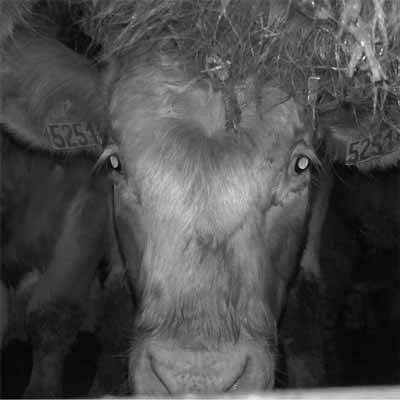
Her fertilization weak colleagues can most often be found in the large industrial farms that go for extreme milk output by high-performance cows. Their short lives, as compared to Helen’s, are offset by a higher milk output. They do not have any names here but have numbers on their earmarks. They usually see the slaughterhouse after only two lactations if the following fertilization is unsuccessful, otherwise they are completely worn out after the 3rd lactation. A cow like that has to yield 17,600-22,000 pounds of milk per lactation, which means that she must give 99 to 110 pounds of milk during the weeks of her highest output. A cow that doesn’t achieve 15,400 pounds during her first lactation is also brought to the slaughterhouse directly afterwards. Another lactation cycle would not “make sense”, the estimated milk output would be too low. On some farms cows are even milked three times a day – twice is customary – and give an average of 35 -40 liters of milk per day. Speaking of “milking”, that, too, is a sentimental term; nowadays it is called “milk extraction.” In some EU states as well as in the USA and Canada, considerably higher volumes, 50 liters and more per day of milk extraction are no rarity at the zenith of lactation. In order to produce these volumes of milk and be pregnant at the same time at least once, a cow must perform incredible metabolic feats. More than 500 liters of blood flow through the udder in order to produce one liter of milk! Huge amounts of milk lead to huge metabolic transfers in the bodies of the animals. No feeds industry and even the most elaborate feed management can make the necessary nutrition available to them. They must pull the required nutrients from their own bodies. And that is exactly where the milk producer’s profit lies. They say that the capital costs per cow do not change as of a certain level or the maintenance expenses per cow remain the same or the feed effectiveness increases with heightened milk output. In straight talk: A cow that gives 44,000 lbs of milk in two lactation periods is more profitable than a cow that needs four lactation periods to do so. That means that the bodies are exhausted more and more. They suffer rumen acidosis, metabolic problems, become emaciated and calcium floods out of their bones. Towards the end of their short four to five-year lifespan they usually break down frequently. Finally, they barely move because they would break their bones otherwise. After finally been released from life and the meat removed from their bones, the butchers in the slaughterhouse see what they see frequently and what they have already gotten used to, the bones of a cow that are so porous they will break.

Print view


Top Concerns - overview